Hi there
on joining the fan club

“Francisco Varela Fan Club” was a name I picked on Twitter a while back, when I got banned and had to make an alt - it was a modification of a joke name I picked (“Kim Deal Fan Club”) because I was really into the Breeders at the time.
But it was one of those things where you stumble into something that becomes more serious over time. I really am a pretty big fan of Francisco Varela (1946-2001). To me he’s a model of what a good scholar looks like - uninterested in artificial disciplinary boundaries, unafraid to go out on a bit of a limb, unconcerned with looking a little bit out there (but still very capable of coming with receipts). And, of course, underneath it all, an unswerving sense of how science broaches the higher realms: society, ethics, the spiritual.
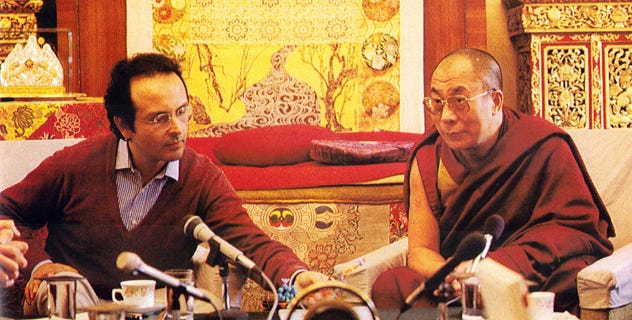
Despite his significant reputation, I still think he’s underrated. Aspects of his multifarious work remain under-discussed, and I think that there is a systematic and consistent philosophical dimension to his research that still awaits its fullest possible treatment. Part of this is because his work touches on so many different areas: biology, origin of life, neuroscience, math, logic, Tibetan Buddhism, cognitive science - even computer science - in addition to philosophy. Another part is probably that “cybernetics” and “systems theory” tend to be goes-everywhere/belongs-nowhere kinds of fields - you won’t find many places where you can go to study ‘cybernetics’ as such, and so it tends to be the kind of thing that everybody has to piece together for themselves.
Varela’s reputation rests primarily on two ideas: autopoiesis and enactive cognition.
The first term (otto-poe-eesis) is a theory of what ‘life’ is, in the biggest sense possible. “Autopoiesis” refers to self-organization (‘auto’ meaning self and ‘poiesis’ a Greek term, common in philosophy, meaning ‘making’) - a living system is one that forms and maintains itself over time.
The second term is a theory of what ‘thinking’ is, also in the biggest sense possible. To say that thinking is ‘enactive’ means that - very roughly - thinking is a doing. It rejects the idea that the brain is like a little mirror that reflects the world or a kind of box that holds something like a model train set-up of the world. In the words of Varela (and his collaborators Thompson and Rosch): “cognition is not the representation of a pre-given world by a pre-given mind but is rather the enactment of a world and a mind on the basis of a history of the variety of actions that a being in the world performs.”
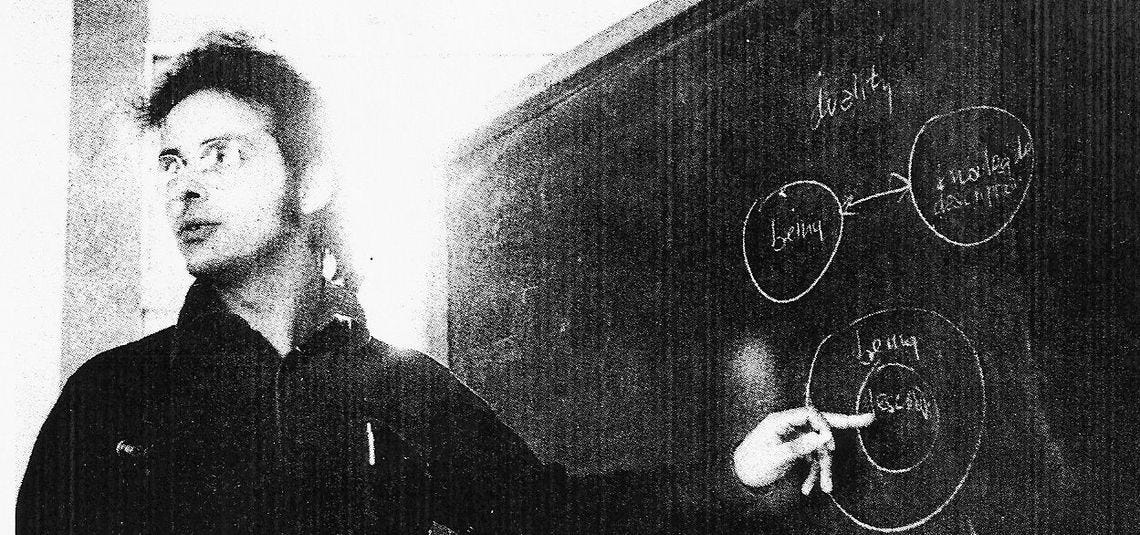
For Varela, to successfully ‘deal with the world’ reflects knowledge. That’s all you need - to just get by is enough. Whether there is also an ability to organize that knowledge into a series of sentences that can be written down and judged by others to be true, well - that’s a different matter entirely.
There’s a lot more to it, obviously, but those thumbnail sketches ought to give you a sense of how wide-ranging and deep Varela’s thought was.
I don’t think I can hope to deliver on that full philosophical retrieval project of Varela’s work on Substack, but what I can do is share my appreciation and hopefully convince other people of the way I see things.
What You Can Expect From Me
An exploration of the extended Varela Cinematic Universe: I hope to provide some accessible (but not reductive) walkthroughs of the work done by Varela, others in the cybernetics/systems theory spheres, and their many fellow travelers. Personally, I enjoy unpacking the math most, but there’ll be plenty of history. Cybernetics, seemingly more than other fields, loves Weird Little Guys, and so there’s some wild little biographical side-jags and fun facts1 for us too.
I think, at first, I’ll aim to post about once or twice a month - probably a conceptual explainer, coverage of a shorter piece, a biographical sketch. If I’m really feeling myself, perhaps it’ll get more frequent (I have two jobs as-is and also a high-maintenance dog2)
One thing that I know I would like to do is a deep-dive - probably chapter by chapter - of Varela’s monograph Principles of Biological Autonomy. This book is probably the most definitive statement of the whole sweep of Varela’s work, but until very recently it was exceedingly hard to get your hands on. Fortunately, MIT Press recently put out a new edition, with helpful annotations. So this very rare, very interesting, and pretty singular book is now very available and very affordable (and there’s even an open-access .pdf!)
Full disclosure: I have a long-term book project that I am working on, of which Varela’s work is a major part. So likely we will shade into that eventually, but if - by that point - you are a card-carrying FVFC member, you’ll be pretty into all that stuff too, I think.
What I Would Like From You
Right now, nothing besides your attention and interest.
I would like, eventually, to make some money off of this, but I am reluctant to ask anybody to pay until there’s enough stuff to make clear that it’s a going concern and not the kind of thing that you’ll realize you’ve been accidentally autopaying for 18 months later.
If you’d like to subscribe right now as a vote of confidence, that’d be marvelous - thanks a bunch. If you’d like to tell a friend to subscribe, even better. But that’s all at the moment.
I hope you’ll consider joining the club.
Fans of “Arrested Development” might be tickled to know that “the first Marta” - before the role was taken over by Patricia Velasquez - is actually Leonor Varela, daughter of Francisco (really).